Intelligence begins
at contact.
The world does not arrive as a clean instruction. An object slips. A surface yields. A familiar task changes.
We are developing the intelligence layer that lets a robot estimate what is happening, rehearse what might happen and choose its next action.
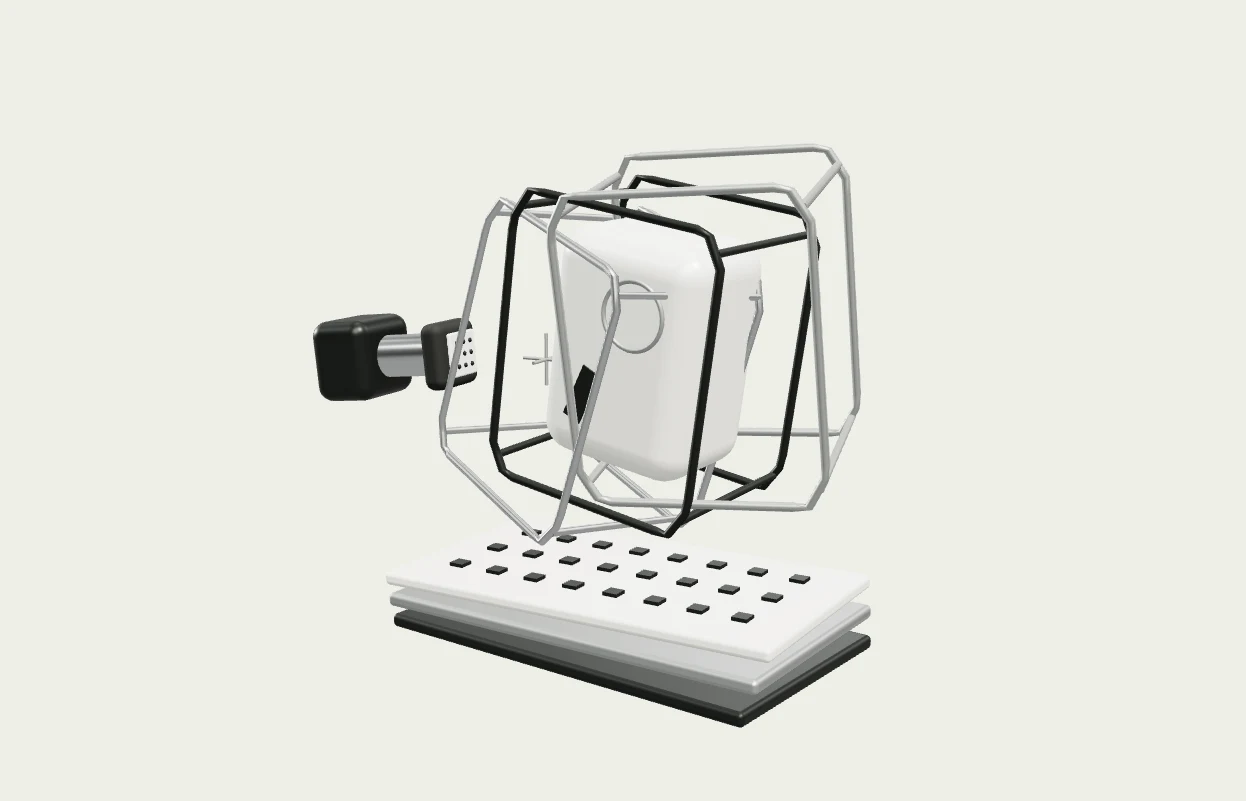
Contact atlas · Three-dimensional study
Keep the uncertainty visible.
The separated frames stand for different estimates of the object’s state. A robot should retain those alternatives when its observations cannot yet distinguish them.
Conceptual 3D diagram with prescribed motion. It does not run a learned policy, state estimator or physics simulation.
Inside Contact atlas
- The object
- The physical situation the robot is trying to understand.
- Candidate states
- Several possible interpretations remain available before the next observation.
- Contact probe
- An action can gather information as well as move an object.
- Observation layers
- Measurements, estimates and intended actions stay distinct in the proposed architecture.
Every action should
answer a question.
Perception, planning and control need a shared account of the body, the task and what remains uncertain.
- Observe
What is happening?
Combine vision, joint state and touch. Keep confidence and missing information alongside the estimate.
- Rehearse
What could happen?
Compare candidate actions against contact, reach, force and failure conditions in a model of the system.
- Act
What should change?
Choose an action the mechanism can execute. Let local feedback respond as the contact changes.
- Reconcile
What did we miss?
Compare the expected result with the measured one. Preserve the difference for the next experiment.
A place to fail
before the world.
We are building an internal simulator to test our systems before they enter the real world.
The aim is to carry the actual mechanism into each experiment: its geometry, joint limits, actuator demands, contacts and uncertainty.
A useful simulation must make its assumptions visible. Friction, compliance, sensor noise and wear can turn an elegant virtual result into a failed physical task.
- Current foundation
- Revisioned engineering workflows, reviewable artifacts and bounded CAD geometry checks.
- Development direction
- Dynamics and contact models, repeatable task scenarios, and policy evaluation against measured hardware.
A general-purpose robot simulator is not yet demonstrated. Simulation results will guide hardware tests; they will not replace them.
The object moved.
Did the grip slip,
or did the skin deform?
The same apparent movement can require very different actions. Tightening the grip could save a tool and bruise a ripe ingredient.
This is the kind of ambiguity we want to study with an instrumented finger: make a prediction, change one condition, measure the contact and compare the explanation with the result.
Meet the first mechanical testbed