Make dexterity
repairable.
Human form. Accessible mechanics. A hand that can return to the task after its wearing parts have been replaced.
Current checkpointOne passive index finger
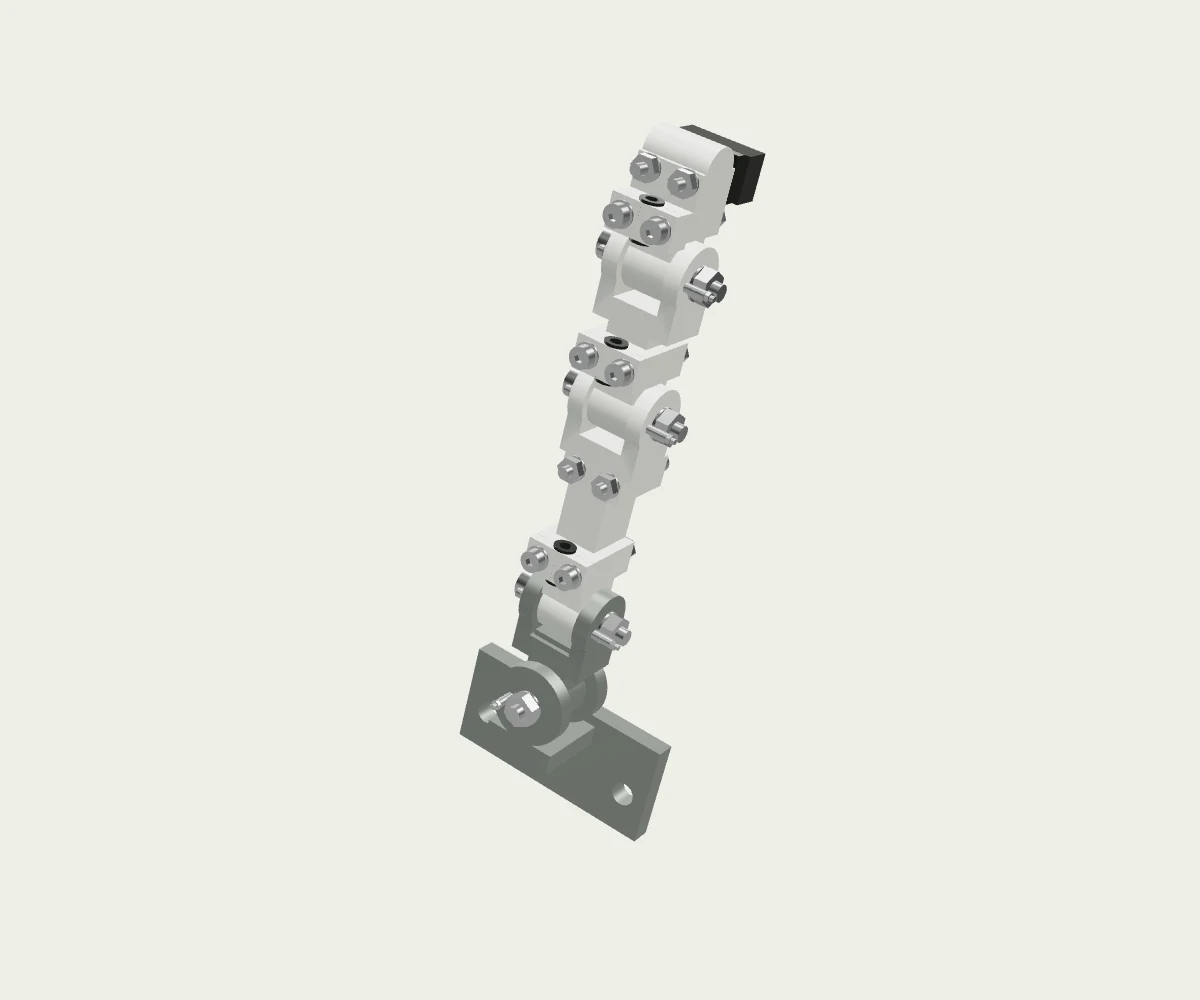
The index-finger checkpoint · Three-dimensional study
The architecture, made inspectable.
These are the placed parts of the current CAD specimen. Rotate, pan and separate the assembly to inspect its construction. This checkpoint establishes passive geometry before adding the drives and feedback that would make it a working finger.
Source-bound CAD visualization. No actuators, working sensors or continuous tendon path are present. Exploded offsets aid inspection; they are not an assembly sequence. The specimen is not manufacturing released.
Inside The index-finger checkpoint
- Joint structure
- Four passive geometric axes, including separate splay and flexion pivots at the finger base.
- Retained pivots
- Metal sleeve and fastener envelopes define the nominal assembly around each joint.
- Finite stops
- Curved slots and stop pins provide explicit geometric travel limits.
- Replaceable guides
- Separate guide and liner components keep wear interfaces accessible.
- Contact pad
- A removable pad sits over an empty carrier reserved for future sensing.
- Bench interface
- The current base supports a finger experiment. A final hand-to-arm interface is future work.
Geometry before
performance.
We checked the parts as an assembly and sampled their passive movement. These are digital geometry results; physical fit, strength and service life still require hardware.
- 22
- Distinct part definitions
- 91
- Placed part instances
- 4
- Passive geometric axes
- 105
- Sampled poses clear of interference
Checkpoint mechanics-03 · Nominal CAD clearances · Sampled poses do not prove collision-free continuous motion.
Borrow the anatomy.
Rethink the service.
A human hand places complexity across bones, tendons, muscles and skin. We are pursuing a modular electric-tendon architecture with a human-shaped envelope, accessible drives and replaceable contact surfaces.
The first drives belong on a bench, where tendon travel, tension, friction and heat can be measured. Compact forearm packaging comes after those demands are understood.
The useful innovation would be dexterity that survives a repair: replace a worn component, recover the calibration and return to the same task. That is a proposition we intend to test.
The wrist turns the hand.
Tendons move the fingers.
In the proposed architecture, forearm motors turn small drums. Guided tendons carry their pull across the wrist to the finger joints. Separate wrist drives orient the hand. Tendons pull; an opposing tendon or return mechanism must reopen the joints and keep the transmission tensioned.
- Arm
- Positions the hand in space.
- Wrist
- Orients the palm toward the task.
- Tendons
- Transmit force to articulate the fingers.
- Feedback
- Measures joint state and tension so the control can correct its motion.
The wrist actuator bank on the homepage sketches the proposed packaging. Its drive count, routing and compensation remain to be designed: turning the wrist must not unintentionally pull the fingers closed.
One finger.
A measured loop.
Turn the passive specimen into an instrumented comparison before scaling it into a complete hand.
- Drive
Route the force.
Add a continuous tendon path, a serviceable drive and an explicit return or preload mechanism. Measure friction and available travel.
- Observe
Close the loop.
Measure joint angles and tendon tension. Compare independently controlled and coupled distal motion on the same task.
- Recover
Repeat after replacement.
Replace a wear component, recalibrate and repeat the test. Record the time, error and any loss of capability.